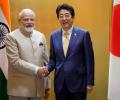
With the signing of the pact, the Quad grouping of India, Japan, Australia and the US is set to gain more heft now, notes Dr Rajaram Panda.
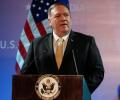
"Whenever we do compromise those rights, the world is worse off," Pompeo said.

Here's the full text of President's Ram Nath Kovind's address to the joint sitting of both houses of Parliament on the first of Budget Session 2022.

As the pandemic unfolded, the India-China relationship has come under severe stress. To restore normalcy, agreements between the two countries must be respected scrupulously in their entirety. Where the Line of Actual Control is concerned, any attempt to unilaterally change the status quo is unacceptable, declares External Affairs Minister Dr Subrahmanyam Jaishankar.

Modi, who arrived on the first leg of his three-nation tour, said his brief visit will further strengthen relations between India and Portugal.

Although the US was among the first to formally recognise his government in 1959, it began working to oust him as Fidel moved into the Soviet bloc.

The prime minister will have a tight schedule in the Philippines as besides attending the 15th ASEAN-India summit and 12th East Asia summit on November 14, he will have a series of other engagements including bilateral meetings with several leaders.

The IAF chief also said Pakistan has become a pawn of Chinese policy and its dependence on China would increase further in future. He said India needs to understand the interplay of some major events in its vicinity that would impact the security scenario of the region.

Defence Minister Manohar Parrikar said that India is in for joint military exercise but not for joint patrolling.
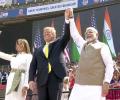
Trump's visit symbolised heightened partisanship and a return to chemistry between leaders defining bilateral ties, notes Kashish Parpiani.

For the current woes of the state to end, in city after city, town after town, village after village, unauthorised constructions have to be removed, no questions asked, says N Sathiya Moorthy.

'Of all the areas that define the future for a strong US-India partnership, none is more important than our defence and security ties.'

As India and the US hold fresh talks on three contentious defence foundational agreements, a top American military official on Wednesday batted for the pacts, saying these are an opportunity for deeper collaboration and cooperation in the key sector.
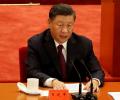
'The world does not care about the tension on our border.' 'India has to emerge as a strong economic power.' 'Respect comes when the world sees a country with a direction and leadership that has a vision,' points out Ramesh Menon.

"We often thought of terrorism as a peripheral problem for this region. The barbaric terrorist strikes in Paris, Ankara, Beirut, Mali and on the Russian aircraft is a stark reminder that its shadow stretches across our societies and our world, both in recruitment and choice of targets," Modi said in his remarks at the East Asia Summit.

There's still little indication of forward movement in Indo-US defence relations.

And learn what not to do from the so far jinxed Navi Mumbai International Airport.

Just like China wants Trump to lose the US presidential poll, it may want Modi to lose the Lok Sabha polls. So months before the 2024 elections, China may take possession of an important area, say one of the Char Dhams, warns Sanjeev Nayyar.

Joe Biden will embark on his maiden visit to India as United States Vice President on July 22 to discuss key bilateral issues, including trade, energy and defence, to make Indo-US ties the most important strategic partnership of the 21st century.
Obstacles in development of SEZs will be removed.
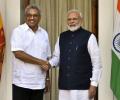
New Delhi is approaching Gota with an open mind, observes N Sathiya Moorthy.

The prime minister's outreach to Japan is a recognition of the civilisational potential that the two nations hold and can wield in evolving an era of 'Asianism' in global politics, says Anirban Ganguly.

'Agreements signed between the Maldives and China have seriously worried India.'

PM Modi addressed the Sri Lanka Parliament on Friday.
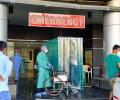
'Our preparation is based on ICMR projections, whatever preparations we have to make.' 'If they project around 70,000 is the maximum number of hospital cases by mid-May or May 30, we are preparing accordingly -- how many people will need hospitalisation.'

Since the US and India broadly share similar interests in Sri Lanka, they should coordinate closely to ensure that the country preserves its democratic institutions, says Lisa Curtis

He said that as the previous government could not do it, he had to do it.
Making it clear that there will be no change in the reservation policy for Dalits, Prime Minister Narendra Modi on Monday asserted that nobody can snatch their right even as he accused his opponents of spreading "untruths" on the issue.

From early indications, the Modi government's foreign policy seems to be pragmatic and reciprocal, says K G Suresh.

The Chinese leader will display his grip on the Communist party and chart his plans for his country's future.

Any official-level talks between India and Sri Lanka, without any clear-cut understanding on the livelihood issues, could end up in India having to acknowledge bilaterally even more than what it had no hesitation in accepting in Parliament and outside, says N Sathiya Moorthy

10 takeaways from the prime minister's UN speech.

Given our troubled relationship with Pakistan, we need to keep our security apparatus in a state of alert with state-of-the-art equipment. All bilateral issues with Pakistan -- political, military, economic -- will simply have to go on the back-burner till Pakistan decides it wants to live as a good neighbour, says Vikram Sood.

'India alone cannot walk the path of peace. It also has to be Pakistan's journey to make,' says Prime Minister Narendra Modi at the government's geo-political flagship initiative "Raisina Dialogue-II".

PM Modi seems to be gradually ending India's strategic ambiguity

Sri Lanka's signals -- that it is ready for 'joint fishing' initiatives -- and Tamil Nadu fishermen's sticking to commitments have paved the way for a negotiated settlement on a long festering issue, says N Sathiya Moorthy

Stepping up his offensive against the Congress, he asked the party to "repent" for what it has not done in the last 60 years.

'Implementation of the US-India Defence Technology and Trade Initiative is as much a test for the Modi government to direct its bureaucratic processes, as it is of US commitment,' says Lieutenant General Anil Chait (retd).

Moving ahead with their new mantra -- Chalein Saath Saath: Forward Together We Go -- Prime Minister Narendra Modi and United States President Barack Obama on Tuesday vowed to deepen cooperation in every sector for the benefit of global stability and people's livelihoods over the next ten years.

President Pranab Mukherjee on Monday addressed the first joint sitting of Parliament as mandatorily required under the Constitution after the general elections. The address is the political, economic and foreign policy road map of the Narendra Modi government and covers virtually all crucial areas.
